DNA sequencer consumables and service for the 3500 series
New and regenerated capillary arrays, POP polymers and buffer containers for 3500 and 3500xL genetic analyzers, plus consumables, maintenance and repair for the 3130, 3730, SeqStudio and thermal cyclers.
- Regenerated arraysA world first for the 3500, with a reprogrammed RFID tag
- 8 and 24 capillariesArrays for the 3500 and 3500xL in 36 cm and 50 cm
- POP-4, POP-6, POP-7Polymer pouches with 96, 384 or 960 samples
- Four regionsSupplying labs in Europe, Asia, the Middle East and Latin America
Regenerated capillary arrays, a world first for the 3500
We clean and regenerate used capillary arrays for the 3500, 3500xL, 3130 and 3130xl, and reprogram the RFID tag of 3500-series arrays, for much less than the price of a new array. ELIS was the first company in the world to do this for the 3500 and, as far as we know, is still the only one.
- Cleaned, regenerated, RFID reprogrammedYour instrument accepts the array and counts its injections again.
- Much lower priceAn original array for much less than a new one, and one array fewer thrown away.
- Online regenerationWe send the washing liquid and a new RFID tag. Our engineers guide you online, or you follow our protocol.
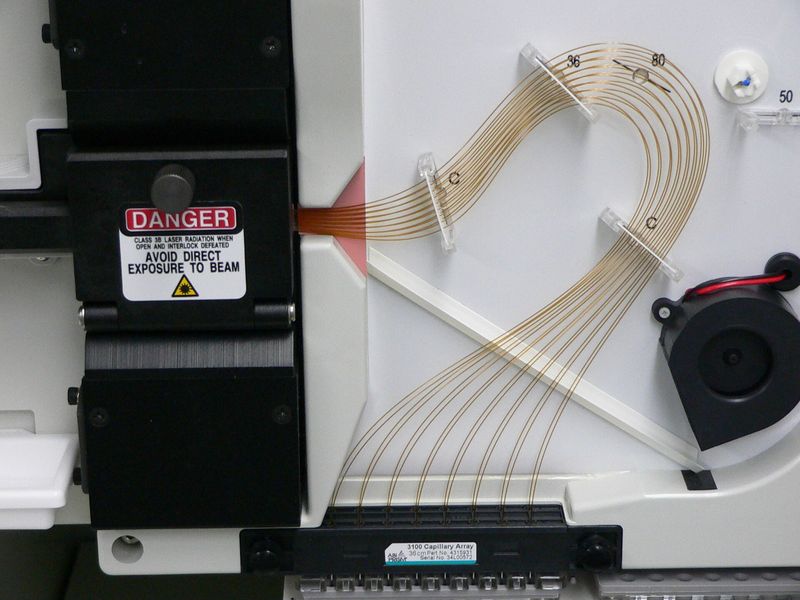

Consumables for 3500 and 3500xL genetic analyzers
Each item is listed next to the OEM part number your lab orders today, so matching your stock takes seconds.
-
Capillary arrays
8-capillary arrays for the 3500 and 24-capillary arrays for the 3500xL, for sequencing and fragment analysis.
- Lengths
- 36 cm, 50 cm
- OEM refs
- 4404683, 4404685, 4404687, 4404689
-
POP-7, POP-6 and POP-4 polymer
POP-7 for sequencing and fragment analysis, POP-6 for high-resolution sequencing, POP-4 for human identification.
- Pouches
- 96, 384, 960 samples
- On instrument
- Up to 14 days at ≤ 25 °C
-
Buffer containers and reagents
Anode and cathode buffer containers, and the conditioning reagent that primes and washes the polymer pump.
- On instrument
- Up to 14 days
- Storage
- 2–8 °C until use
Instruments we support
Consumables, maintenance and repair for the capillary electrophoresis systems and thermal cyclers found in most genetics laboratories.
-
3500 and 3500xL
New and regenerated arrays, POP pouches and buffers, including the Dx versions.
-
3130 and 3130xl
Arrays, regenerated arrays, polymer bottles and running buffer.
-
3730 and 3730xl
48- and 96-capillary arrays, POP-7, running buffer and online array regeneration.
-
SeqStudio Flex
Arrays for the 8 Flex and 24 Flex, with pouches and buffers shared with the 3500.
-
SeqStudio
Cartridge v2, cathode buffer containers and service for the 4-capillary benchtop.
-
Thermal cyclers
Temperature verification, maintenance and repair for Veriti, ProFlex, 9700 and more.
Maintenance and repair for genetic analyzers and PCR instruments
Preventive maintenance, spatial and spectral calibration and troubleshooting for capillary electrophoresis systems, plus temperature verification for thermal cyclers and real-time PCR instruments. On site or remotely, with a written service report.
Genetic analyzer service
Maintenance, calibration and repair for the 3500 series, 3130, 3730, SeqStudio and SeqStudio Flex.
Online array regeneration
A washing liquid and a new RFID tag, with our engineer online or with our protocol.
PCR and qPCR instrument service
Block temperature verification, optical calibrations and maintenance.
How a service request works
Send the model and the symptom
Serial number, software version and a screenshot of the error or the electropherogram help us prepare.
Remote diagnosis
We review logs and data with you and confirm what needs adjusting or replacing.
Repair on site or guided
An engineer visits, or we guide your team step by step for simple jobs.
Verification and report
Calibration and a test run confirm the result. You receive a report with the values measured.
Which consumables fit your instrument?
The capillary count and array length decide which array you need, and the polymer format changes between instrument families. The full compatibility chart adds buffers and every OEM part number.
| Instrument | Capillaries | Capillary arrays | Polymer |
|---|---|---|---|
| 3500 Genetic Analyzer | 8 | 36 cm 4404683 50 cm 4404685 | POP-4, POP-6, POP-7 pouches |
| 3500xL Genetic Analyzer | 24 | 36 cm 4404687 50 cm 4404689 | POP-4, POP-6, POP-7 pouches |
| SeqStudio 8 Flex Genetic Analyzer | 8 | 36 cm A49104 50 cm A49106 | Same as 3500 series |
| SeqStudio 24 Flex Genetic Analyzer | 24 | 36 cm A49105 50 cm A49107 | Same as 3500 series |
| SeqStudio Genetic Analyzer | 4 | Built into the SeqStudio Cartridge v2 (28 cm) | POP-1 inside the cartridge A41331 |
| 3730 DNA Analyzer | 48 | 36 cm 4331247 50 cm 4331250 | POP-7 bottle, 28 mL 4363929 |
| 3730xl DNA Analyzer | 96 | 36 cm 4331244 50 cm 4331246 | POP-7 bottle, 28 mL 4363929 |
| 3130 / 3100-Avant Genetic Analyzer | 4 | 36 cm 4333464 50 cm 4333466 | POP-4, POP-6, POP-7 bottles |
| 3130xl / 3100 Genetic Analyzer | 16 | 36 cm 4315931 50 cm 4315930 | POP-4, POP-6, POP-7 bottles |
Swipe sideways to see all columns.
OEM part numbers are shown for cross-reference only, so you can match what your instrument uses today.
Practical guides for capillary electrophoresis
Written for the people who run the instrument every day, and free to print and share in your lab.
Compatibility chart
Arrays, polymers and buffers for each Applied Biosystems genetic analyzer, with OEM part numbers.
3500 troubleshooting guide
Likely causes and fixes for spikes, weak signal, broad peaks, pull-up, current errors and failed calibrations.
Maintenance checklist
A printable schedule of daily, 14-day, monthly and yearly tasks for the 3500 and 3500xL.
Supplying laboratories in four regions
We deliver consumables and arrange service for laboratories in Europe, Asia, the Middle East and Latin America. Tell us your country with the request and we confirm the delivery time and shipping cost.
How we work explains what to expect from us.
- Europe
- Asia
- Middle East
- Latin America
Questions labs ask us
Which capillary array do I need for a 3500 or 3500xL?
The 3500 uses an 8-capillary array and the 3500xL a 24-capillary array. Both come in 36 cm and 50 cm. Choose the length your run modules are set up for: 36 cm for fast runs and most fragment analysis, 50 cm for longer sequencing reads.
What is the difference between POP-7, POP-6 and POP-4?
POP-7 is the general-purpose polymer for sequencing and fragment analysis. POP-6 gives higher resolution for sequencing, with longer run times. POP-4 is optimized for human identification (HID) fragment analysis.
How long can polymer stay on a 3500?
Up to 14 days at or below 25 °C. Above 25 °C, POP-7 should be replaced after 7 days. The instrument also tracks the injection limit of each pouch and asks for a new one when either limit is reached.
Do you list OEM part numbers?
Yes. Every product shows the matching OEM part number for cross-reference, for example 4404685 for the 3500 8-capillary 50 cm array or 4393714 for the 960-sample POP-7 pouch.
What is a regenerated capillary array?
An original array that has been used and then cleaned, regenerated and, for the 3500 series, fitted with a reprogrammed RFID tag. It costs much less than a new array. See regenerated capillary arrays.
Which instruments do you supply and service?
The 3500 and 3500xL with their Dx versions, the 3130 and 3130xl, the 3730 and 3730xl, the SeqStudio Flex and SeqStudio, and thermal cyclers and real-time PCR systems.
Can I regenerate the arrays I already have?
Yes, for the 3130, 3130xl, 3730, 3730xl, 3500, 3500xL, 3500 Dx, 3500xL Dx and SeqStudio Flex. We send a washing liquid and, where the instrument reads RFID tags, a new tag; our engineers guide you online, or you follow our protocol.
How do I request a quote?
Use the quote form or email us the instrument model, the items and the quantities. We reply with price, availability and delivery time.
Tell us your instrument and what you need
Send the model and the consumables or service you need. We reply with availability, price and delivery time.