Key facts
- Focused on the 3500 series, including the Dx versions, with full support for the 3130, 3730, SeqStudio Flex and SeqStudio.
- Preventive maintenance, spatial and spectral calibration, polymer pump service, autosampler checks and performance verification with standards.
- Remote diagnosis first: many problems are solved without a visit.
- Every visit ends with a written report of the work done and the values measured.
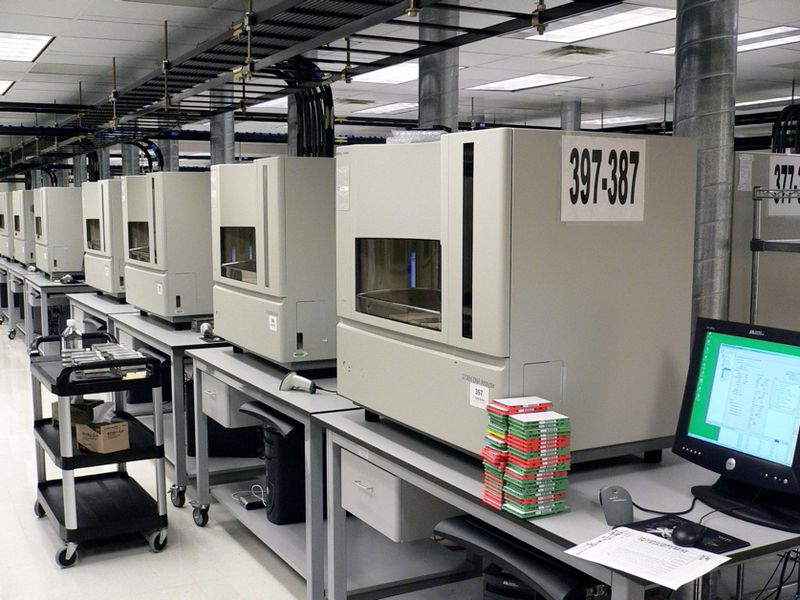

What a preventive maintenance visit covers
- Inspection of the polymer delivery pump, pump block, array port and seals for leaks and dried polymer; cleaning and flushing of the pump and water trap.
- Check of autosampler movement, plate positioning and electrodes.
- Inspection of the oven and detection cell, with cleaning where needed.
- Check of signal intensity against the expected levels for your instrument.
- Spatial calibration and spectral calibration for the dye sets you use.
- Test run with a sequencing standard or size standard, and review of the data quality.
- Computer check: database size, free disk space and backups of your run modules and protocols.
- Written report with findings, measured values and recommendations.
Common repairs
- Unstable current or arcing: leaks, bubbles, aged buffer or contaminated electrodes.
- Pump problems: polymer leaks at the pump block, piston or valve faults, bubbles that the wizard cannot remove.
- Autosampler errors: positioning faults and failed tray movements.
- Calibration failures: spatial or spectral calibrations that will not pass.
- Status light errors: a steady yellow light (no communication between computer and instrument) or a steady red light (the instrument cannot initialize).
Send us the error message and, if you can, an electropherogram that shows the problem. It often tells us which part is involved before anyone travels.
How a service request works
Send the model and the symptom
Include the serial number, software version, error messages and a screenshot of the data.
Remote diagnosis
We review logs and raw data with you and agree what needs adjusting or replacing.
Repair on site or guided
An engineer visits with the parts, or we guide your team through simple jobs such as bubble removal or reseating the array.
Verification and report
Calibrations and a standard run confirm the result. You receive a report for your records.
Spatial and spectral calibration
Spatial calibration tells the software where the signal of each capillary falls on the detector. Run it after installing or moving an array, and after any work on the detection block.
Spectral calibration separates the overlapping emission of the dyes. Run it for each dye set after an array change, after a change of polymer type, after optics work, or when pull-up peaks appear across many runs. Check the result against the limits for your dye set: laboratories commonly require a quality value of at least 0.95 together with a condition number within the dye set’s limit.
Online regeneration of capillary arrays
Arrays often reach their RFID limit or lose resolution long before their capillaries are worn out. For the 3130, 3130xl, 3730, 3730xl, 3500, 3500xL, 3500 Dx, 3500xL Dx and SeqStudio Flex, we send a special washing liquid and, where the instrument reads RFID tags, a new RFID tag. Our engineers then regenerate the array with your team in an online session, or you follow our written protocol. See online regeneration.
Frequently asked questions
Which instruments do you service?
The 3500 and 3500xL with their Dx versions, the 3130 and 3130xl, the 3730 and 3730xl, the SeqStudio Flex and the SeqStudio. Send the model and serial number and we confirm before booking.
Can you help remotely?
Yes. We review logs, screenshots and raw data with you and guide simple fixes such as bubble removal, pump flushing or reseating the array. A visit is booked only when it is needed.
How often should a genetic analyzer be serviced?
A preventive maintenance visit once a year is common practice, with routine user maintenance in between: polymer and buffer changes at least every 14 days, monthly pump flushing, and calibrations after every array change.
Do you provide a service report?
Yes. Every visit ends with a written report listing the work done, the values measured and any parts replaced, ready for your equipment records.
Can you regenerate capillary arrays remotely?
Yes. We send the washing liquid and, for RFID instruments, a new RFID tag, and our engineer regenerates the array with your team in an online session. If you prefer, you follow our written protocol on your own.
Related pages
Regenerated arrays
Regenerated arrays for the 3500, 3500xL, 3130 and 3130xl, and online regeneration with a kit and remote support.
Maintenance checklist
A printable schedule of daily, 14-day, monthly and yearly tasks for the 3500 and 3500xL.
3500 troubleshooting guide
Likely causes and fixes for spikes, weak signal, broad peaks, pull-up, current errors and failed calibrations.
PCR and qPCR service
Block temperature verification for thermal cyclers and optical calibrations for real-time PCR instruments.