Key facts
- Block temperature verification at several set points, reporting accuracy and well-to-well uniformity.
- Real-time PCR maintenance with background, uniformity, region-of-interest and dye calibrations, as the instrument requires.
- Cleaning of blocks, heated lids, fans and air filters.
- A written report with measured values for your quality system.

Why verify a thermal cycler?
Block temperatures drift as Peltier elements age. A block that runs one degree off at the annealing step can lower yield or produce non-specific products, and an uneven block makes replicate wells behave differently. Regular verification shows that the instrument still meets its specification, and accredited laboratories need that record for ISO 15189 or ISO/IEC 17025 audits.
Thermal cycler verification
- Temperature accuracy at the set points you use, typically denaturation, annealing and extension temperatures.
- Uniformity across the block, measured at several well positions at once.
- Heating and cooling behaviour, including overshoot and hold stability where the instrument allows.
- Heated lid function and block cleanliness.
- Pass or fail against the manufacturer’s specification, with every measured value in the report.
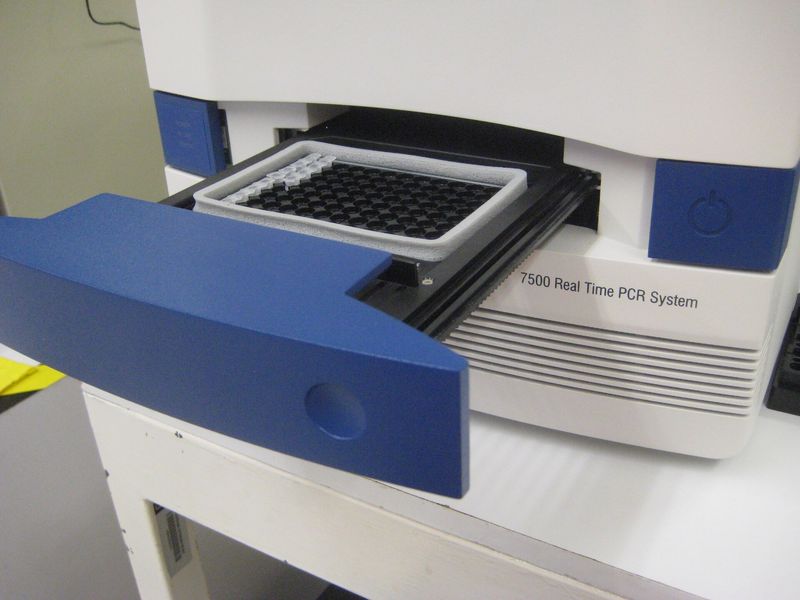
Real-time PCR maintenance
- Inspection and cleaning of the block and optical path.
- Background and uniformity calibrations.
- Region-of-interest or well-position calibration.
- Dye (pure spectra) calibrations for the dyes your assays use.
- A verification run, for example with an RNase P plate on systems that support it.
How often?
Most laboratories verify thermal cyclers and service real-time PCR instruments once a year, and more often for instruments used in accredited or diagnostic methods. Follow your quality system and the manufacturer’s maintenance guide; we can schedule repeat visits so every instrument stays within its calibration interval.
Frequently asked questions
Which thermal cyclers and qPCR instruments do you support?
Applied Biosystems thermal cyclers such as the Veriti, ProFlex, SimpliAmp and GeneAmp 9700, real-time PCR systems such as the 7500, StepOnePlus and QuantStudio, and other brands on request. See thermal cyclers for the models we see most often.
Can the report be used for ISO audits?
The report lists the instrument, the measurement method and every value measured, so you can file it as an equipment record. If your auditor requires an accredited calibration certificate, tell us before the visit.
What should we prepare before the visit?
Keep the instrument free for the planned time, have the last calibration records and any error logs ready, and make sure the instrument computer and software are accessible.
What does real-time PCR maintenance include?
Cleaning of the block and optical path, background and uniformity calibrations, region-of-interest calibration, dye calibrations for the dyes you use and a verification run, as the instrument requires.
Related pages
Thermal cyclers
Supported thermal cyclers, common faults, cleaning and temperature verification.
Genetic analyzer service
Preventive maintenance, calibration and repair for the 3500 series, 3130, 3730 and SeqStudio, on site or remotely.
Contact
Quote requests and contact details.