Key facts
- Regenerated arrays for the 3500 (8 capillaries), 3500xL (24), 3130 (4) and 3130xl (16), in 36 cm and 50 cm.
- Every array is cleaned and regenerated; arrays for the 3500 series also get a reprogrammed RFID tag.
- ELIS was the first company in the world to regenerate 3500 capillary arrays and, as far as we know, is still the only one.
- Online regeneration for arrays of the 3130, 3130xl, 3730, 3730xl, 3500, 3500xL, 3500 Dx, 3500xL Dx and SeqStudio Flex.
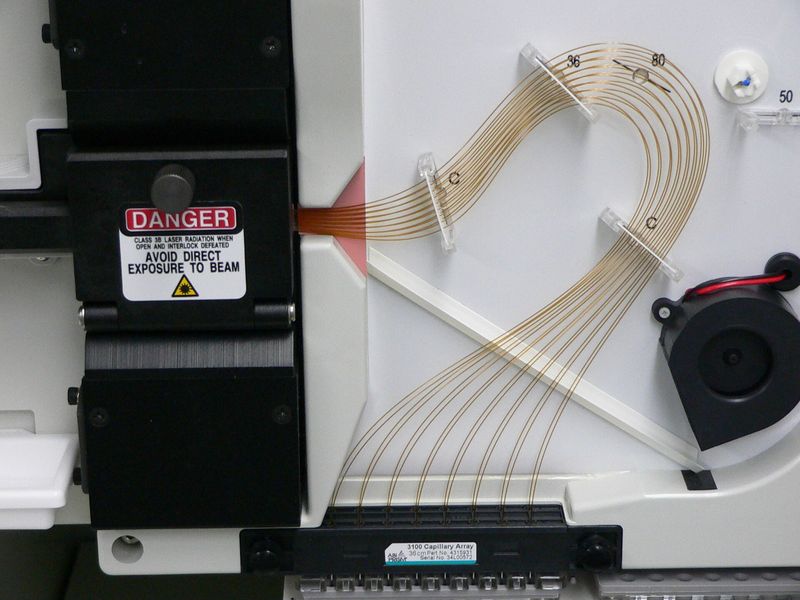

Available regenerated arrays
| Product | Instrument | Capillaries | Array length | Replaces OEM | Price |
|---|---|---|---|---|---|
| Regenerated 8-capillary array, 36 cm | 3500 | 8 | 36 cm | 4404683 | Ask for price |
| Regenerated 8-capillary array, 50 cm | 3500 | 8 | 50 cm | 4404685 | Ask for price |
| Regenerated 24-capillary array, 36 cm | 3500xL | 24 | 36 cm | 4404687 | Ask for price |
| Regenerated 24-capillary array, 50 cm | 3500xL | 24 | 50 cm | 4404689 | Ask for price |
| Regenerated 4-capillary array, 36 cm | 3130 | 4 | 36 cm | 4333464 | Ask for price |
| Regenerated 4-capillary array, 50 cm | 3130 | 4 | 50 cm | 4333466 | Ask for price |
| Regenerated 16-capillary array, 36 cm | 3130xl | 16 | 36 cm | 4315931 | Ask for price |
| Regenerated 16-capillary array, 50 cm | 3130xl | 16 | 50 cm | 4315930 | Ask for price |
Swipe sideways to see all columns.
Regenerated original arrays. The OEM part number shows the new array that each one replaces.
Why regenerate a capillary array?
Most arrays are retired before their capillaries are worn out. On the 3500 series, the RFID tag counts every injection, and the instrument stops accepting the array once the tag reaches its limit or its expiry date. On every instrument, dried polymer, salts and contaminants left on the capillary walls slowly broaden peaks and shorten reads.
Regeneration deals with both causes. Cleaning removes the deposits from the capillaries, and on the 3500 series a reprogrammed RFID tag lets the instrument accept the array again. You keep running on an original array, pay much less than for a new one, and send one array fewer to waste.
What regeneration includes
- Cleaning and regeneration. The capillaries are cleaned of old polymer, salts and contaminants and regenerated, ready for a new series of runs.
- RFID reprogramming. On 3500-series arrays the RFID tag is reprogrammed, so the instrument reads the array and counts its injections again.
- The same array format. The array keeps its capillary count and length, so it works with the run modules your lab already uses.
Arrays for the 3130 and 3130xl have no RFID tag, so for them regeneration means cleaning and regenerating the capillaries.
Online regeneration of your own arrays
If your lab has arrays that have reached their limit, you do not have to send them anywhere. ELIS sends you a kit with a special liquid for washing the capillaries and, for instruments that read an RFID tag, a new RFID tag to replace the expired one. Then you choose how to work:
- With our engineer online. Our engineers carry out the regeneration with you through online support.
- On your own. We send our written protocol, and your team follows it step by step.
Online regeneration is available for arrays of these instruments:
- 3130
- 3130xl
- 3730
- 3730xl
- 3500
- 3500xL
- 3500 Dx
- 3500xL Dx
- SeqStudio Flex
| Product | Contents | For | OEM part no. (reference) | Price |
|---|---|---|---|---|
| Online regeneration kit with new RFID tag | Washing liquid, new RFID tag, online session or protocol | 3500 / 3500xL / 3500 Dx / 3500xL Dx / SeqStudio Flex | – | Ask for price |
| Online regeneration kit | Washing liquid, online session or protocol | 3130 / 3130xl / 3730 / 3730xl | – | Ask for price |
Swipe sideways to see all columns.
You regenerate the array in your lab, with our engineer in an online session or with our written protocol.
How online regeneration works
Tell us about the array
Send the instrument model, the number of capillaries, the length and, if you have them, the part number and injection count of each array.
We ship the kit
You receive the washing liquid and, for 3500-series and SeqStudio Flex arrays, a new RFID tag for each array.
Regenerate the array
Our engineer guides your team through the process in an online session, or you follow our written protocol.
Calibrate and check
Install the array, run a spatial and a spectral calibration, and check a sequencing or size standard before the first samples, as you would with a new array.
Regenerated arrays in accredited laboratories
A regenerated array installs and runs like the original, with the same run modules and calibrations. Laboratories that work under ISO 15189 or ISO/IEC 17025, or that report diagnostic results with a 3500 Dx in IVD mode, treat it like any other change of consumable: run your sequencing or size standard, compare the result with your reference data and record it in your validation file.
Frequently asked questions
What is the difference between a new and a regenerated capillary array?
A new array comes straight from the manufacturer. A regenerated array is an original array that has been used, then cleaned, regenerated and, on the 3500 series, given a reprogrammed RFID tag. It fits and runs like the original, for much less than the price of a new array.
Will my 3500 or 3500xL accept a regenerated array?
Yes. The reprogrammed RFID tag lets the instrument read the array and count its injections again, so the Data Collection Software accepts it like a new array.
Which instruments can use regenerated arrays?
We supply regenerated arrays for the 3500, 3500xL, 3130 and 3130xl, in 36 cm and 50 cm. Online regeneration also covers arrays of the 3730, 3730xl, 3500 Dx, 3500xL Dx and SeqStudio Flex.
How does online regeneration work?
We send the washing liquid and, for instruments that use RFID tags, a new tag for each array. Our engineer then regenerates the array with you in an online session, or your team follows our written protocol.
Is ELIS the only company that regenerates 3500 arrays?
ELIS was the first company in the world to offer regeneration of 3500 capillary arrays and, as far as we know, is still the only one.
Why does my 3500 refuse an array that still gives good data?
The instrument reads the array’s RFID tag and stops accepting the array when the tag reaches its injection limit or expiry date, even if the capillaries still separate well. A reprogrammed or replaced RFID tag solves this.
Can I use a regenerated array on a 3500 Dx?
Online regeneration works for 3500 Dx and 3500xL Dx arrays. If you report diagnostic results in IVD mode, validate the regenerated array within your quality system before use, as you would for any change of consumable.
How do I order a regenerated array or a regeneration kit?
Use the quote form with the instrument model, the number of capillaries, the length and the quantity. We reply with price and delivery time.
Related pages
Capillary arrays
8- and 24-capillary arrays for the 3500 and 3500xL in 36 cm and 50 cm, with installation and storage tips.
3500 and 3500xL
Arrays, polymer, buffers and service for the 3500, 3500xL and their Dx versions.
3130 and 3130xl
Arrays, polymer, buffer, maintenance and service for the 3130 and 3130xl.
Genetic analyzer service
Preventive maintenance, calibration and repair for the 3500 series, 3130, 3730 and SeqStudio, on site or remotely.