Key facts
- We work on Applied Biosystems thermal cyclers such as the Veriti, VeritiPro, ProFlex, SimpliAmp, MiniAmp, 2720 and GeneAmp 9700, and on other brands on request.
- Temperature verification measures accuracy and uniformity across the block at the set points you use.
- Most labs verify each cycler once a year, and more often for accredited or diagnostic methods.
- You receive a written report with every value measured.
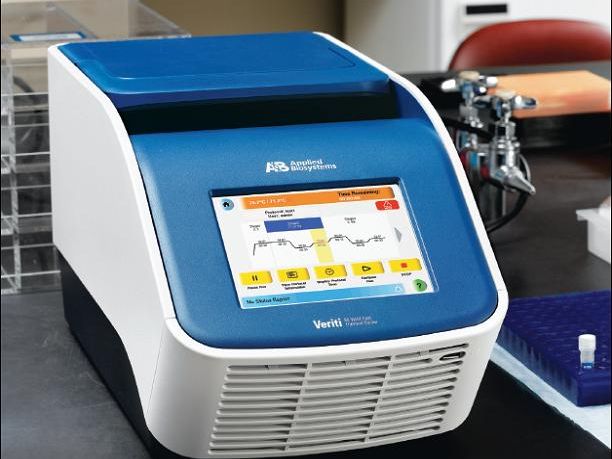

Thermal cyclers we work on
| Model | Block formats | Notes |
|---|---|---|
| VeritiPro | 96-well 0.2 mL, 384-well | Six VeriFlex zones on 96-well blocks |
| Veriti | 96-well 0.2 mL, 384-well, 60-well 0.5 mL | Six VeriFlex zones on 96-well blocks |
| ProFlex | 3 × 32-well, 2 × 96-well, flat blocks | Runs several protocols at once |
| SimpliAmp | 96-well 0.2 mL | Three VeriFlex zones |
| MiniAmp, MiniAmp Plus | 96-well 0.2 mL | Three VeriFlex zones on the Plus |
| GeneAmp PCR System 9700 | Interchangeable 96- and 384-well blocks | Widely used older model |
| 2720 | 96-well 0.2 mL | Compact single-block cycler |
For real-time PCR systems such as the 7500, StepOnePlus and QuantStudio, see PCR and qPCR service.
Faults we see most often
Heated lid errors
The heated cover does not reach its temperature or reports an error, and condensation in the tubes or evaporated samples follow. Causes range from a worn heater or sensor to a lid that no longer closes with the right pressure.
Block out of specification
Edge or corner wells give lower yield or extra bands, or a verification shows wells outside the tolerance. Ageing Peltier elements and poor thermal contact are the usual causes, and a verification run shows which zones drift.
Slow ramps and overheating
Dust on the air intakes and fans, or too little space around the instrument, slows cooling and can stop a run. Clean the vents and keep the clearance the user guide asks for.
No start, frozen screen or self-test errors
Power supply faults, failing displays and firmware problems usually need a technician. Note the error message and the firmware version before you call.
Cleaning and care
- Switch the instrument off and let the block cool down before you clean it.
- Clean the wells regularly with cotton swabs and 70% isopropanol, then let them dry.
- If a sample spills, clean the block with the agents your user guide allows and rinse as it describes.
- Use tubes and plates made for your block format, and set the heated cover as your protocol requires.
- Keep the air vents free of dust and do not block them with other equipment.
Temperature verification
A verification measures the block with calibrated probes at the temperatures your protocols use, typically denaturation, annealing and extension, and reports accuracy and well-to-well uniformity against the manufacturer’s specification. Accredited laboratories need this record for ISO 15189 or ISO/IEC 17025 audits. The PCR and qPCR service page explains what the report contains.
Frequently asked questions
How often should a thermal cycler be verified?
Most laboratories verify each thermal cycler once a year, and more often when it is used for accredited or diagnostic methods. Follow your quality system and the manufacturer’s maintenance guide.
Do you work on thermal cyclers from other brands?
Our focus is on Applied Biosystems models, and we take other brands on request. Send the brand, the model and the problem, and we tell you what we can do.
Why do the edge wells give lower yield?
Usually because of temperature differences across the block, evaporation when the heated lid does not press evenly, or plates that do not fit the block. A temperature verification shows whether the block itself is within specification.
What causes a heated lid error?
A worn heater or temperature sensor, a damaged cable or a lid mechanism that no longer closes properly. Condensation on the tube caps is often the first sign.
How should I clean the sample block?
With the instrument switched off and cool, clean the wells with cotton swabs and 70% isopropanol and let them dry. For spills, use only the cleaning agents listed in your user guide.
Do you also service real-time PCR systems?
Yes. For systems such as the 7500, StepOnePlus and QuantStudio we carry out maintenance with background, uniformity and dye calibrations. See the PCR and qPCR service page.
Related pages
PCR and qPCR service
Block temperature verification for thermal cyclers and optical calibrations for real-time PCR instruments.
Genetic analyzer service
Preventive maintenance, calibration and repair for the 3500 series, 3130, 3730 and SeqStudio, on site or remotely.
Contact
Quote requests and contact details.